
“New Mexico in 1776” by F.R. Bob Romero
On July 4, 1776, 250 years ago, the thirteen colonies on the eastern seaboard declared their independence in their efforts to throw off the yoke of British imperialism. In that same year in New Mexico, in today’s Southwestern part of the United States of America, much human activity was taking place which was well documented.
In 1776, Juan Bautista de Anza was the military commander of the Presidio of San Francisco, California; as such he is recognized as the Spanish founder of San Francisco. In 1778 Anza was reassigned and transferred to New Mexico as Governor. (1) New Mexico had been referred to as Nuevo Mexico since the Rodriguez/ Chamuscado Expedition in 1581, and then the place name was formalized when New Mexico was colonized by Don Juan De Onate in 1598. (2)
After the Pueblo Revolt of 1680 and the completion of the “Reconquista” led by Don Diego de Vargas in 1696, The Spanish colony of New Mexico was in a high state of development throughout the 1700s. The blended Spanish settlers returned to New Mexico with the intention to work the land and develop an agrarian society based on faith, shared family values, and community. They constructed placitas, churches, and plazas or town squares, for example Ranchos Plaza in 1779 and Taos Plaza in 1796. They continued to build the acequia irrigation systems and to develop, through settlement and cultivation, the land grants being issued by the Spanish government.
Large adobe mission churches were built in numerous communities and pueblos. The Catholic faith was very important and religious processions and fiestas for each church or chapel were regular occurrences. The Spanish Colonists survived by utilizing the methods of regenerative agriculture. Fields were planted and irrigated yearly. To plant a seed and let water onto the grounds were venerable acts of faith. They cared for their domestic animals –horses, mules, cattle, pigs, and sheep – that had been transported from Spain, and that were essential for survival.
The enormity of the task of building a society of survival through subsistence agriculture and barter was difficult enough, but the Spanish settlers as well as the Pueblo people were under a relentless siege during the eighteenth century by the nomadic tribes that included the Navajo, Ute, Apache, and Comanche nations. In 1776 the northernmost Spanish colony of New Mexico was truly hanging on by a thread. (3)
It fell upon “a perfect oak of a man”, Governor Juan Bautista de Anza, to save New Mexico. When Anza arrived in New Mexico as governor he assessed the situation and in 1779 he organized a military campaign into present day Colorado, and decisively defeated Cuerno Verde, the Comanche chief and his warriors. He then used diplomacy to enter into a peace treaty with the Comanche Nation in 1786. (4) This event reduced tensions between the nomadic tribes and Nuevo Mexicanos for about one hundred years. It wasn’t the beginning of a new nation but it was the dawn of a period of relative peace and progress.
Fray Francisco Atanasio Dominguez had arrived in Santa Fe, New Mexico on March 22, 1776. The instructions he received from his superiors were to “make a complete detailed report on both the spiritual and economic status of the New Mexico missions, and this entailed the gathering of much geographical and ethnological data”. (5) Dominguez in his report described “the wretched panic stricken state in which the nomadic Indian attacks had reduced the settlements and missions of New Mexico.” (6) Generally, he described in detail the conditions he found in New Mexico in 1776. He recorded the “utter poverty and loneliness” the Hispanic folk who for generations had survived among perils and hardships that might have driven other people to desertion, if not extinction.” (7) Father Dominguez in his Visitor Report also made a valuable detailed description of the Taos Pueblo and the second San Jeronimo mission church at Taos Pueblo, built between 1706 and 1726. Today only the ruins remain of this structure that was destroyed by the United States Army in the Taos Revolt/Resistance of 1847. (8)
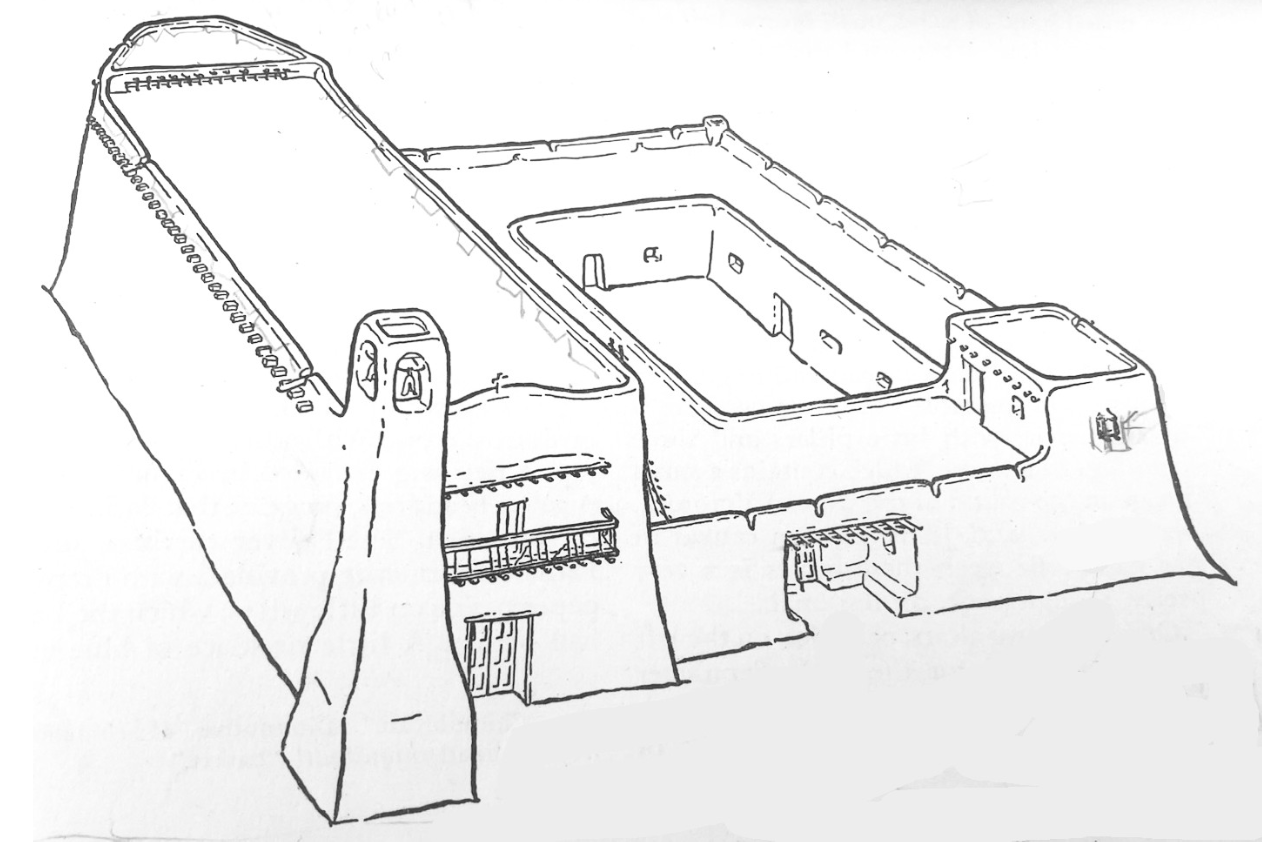
San Jeronimo Mission Church, built 1706-1726, destroyed 1847
In addition, during his visit Father Dominguez teamed up with Father Velez de Escalante for the purpose of leading an expedition to find a new route to Monterey California. The Domiguez/ Escalante Expedition departed Santa Fe on July 29, 1776 and explored throughout the Western Slope of Colorado and into Utah and Arizona but failed to reach California. They blazed a new trail for over a thousand miles in unexplored and uncharted wilderness and documented geographical information and the topography of the area and the existence of other tribes such as the Yutas. (9)
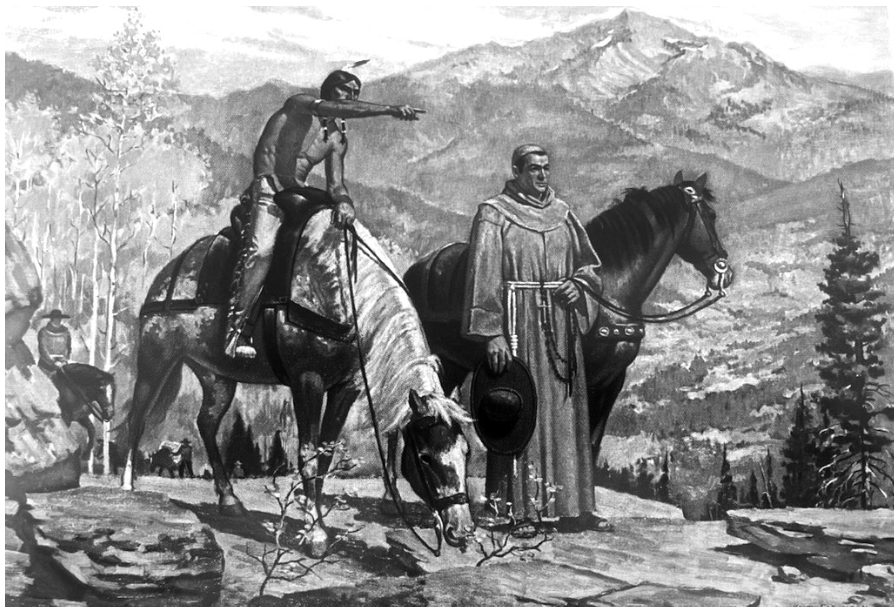
Father Dominguez’s lengthy 1776 Report was filed away and then discovered in 1928 by Dr. Frances V. Scholes in the National Library of Mexico among unsorted papers from the past. It was a “meticulous record of the most common place appurtenances of everyday life” in New Mexico in the 1700s. (10) So while the “Second Continental Congress was drafting at Philadelphia” the Declaration of Independence that marked the birth of a new nation, the Spanish Empire and its colonists were busy living, surviving, and documenting a historical treasure trove of information about life and “society in eighteenth century New Mexico.” (11) In hindsight we should acknowledge and be grateful to our historians of the past that recorded what was happening 250 years ago in the Eastern United States and in New Mexico.
FOOTNOTES
Carlos R. Herrera, Juan Bautista de Anza; The Kings Governor in New Mexico (Norman: University of
Oklahoma Press), 2015, p. 72.
John L. Kessel, Spain in the Southwest (Norman: University of Oklahoma Press) 2002, p.97. Also refer to Marc, Simmons, New Mexico, An Interpretive History (Albuquerque: University of New Mexico Press) 1988, p. 30.
F.R. Bob Romero, Roots of Enchantment, (Taos: Nighthawk Press) 2018, p 19.
Ibid. p. 19-20.
Eleanor B. Adams, Fray Angelico Chavez, The Missions of New Mexico 1776 (Albuquerque: University of New Mexico Press) 1956, p. xv.
Ibid. p. xv.
Ibid. p. xviii.
Ibid. p. 101-113.
Ibid. p. xvi. Also refer to Ted J. Warner, ed., The Dominguez-Escalante Expedition Journal, (Salt Lake City: University of Utah Press) 1995, pp. 3-4 and Herbert E. Bolton, Pageant in the Wilderness (Salt Lake City: Utah State Historical Society) 1950, p. 10.
Ibid.p.xviii.
Ibid. p. xii.
Acknowledgment: We’d like to thank Bob for kindly giving us permission to share his article. It will also appear in the Taos County Historical Society newsletter, Ayer y Hoy en Taos, Summer 2026 Issue No. 60.